
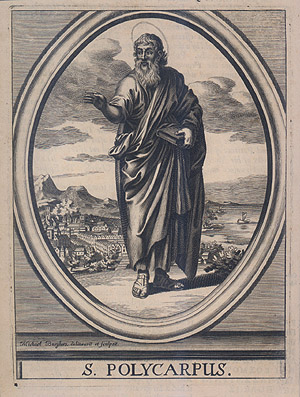
Polycarp was born in 69 AD and died in 156 AD. The tale of his martyrdom was chronicalled by eyewitnesses around 160 AD.
He was a member of the early church. He was a part of the second generation of believers. John the Apostle discipled him and he was appointed as bishop of Smyrna (in modern Izmir, Turkey) by some of the original apostles.
When he died at age 86, Polycarp was one of the last people alive to personally know one of the apostles. Many Christians in the Roman Empire were persecuted and killed for their refusal to sacrifice to pagan gods.
Polycarp was responsible for converting many people from Gnosticism, the belief in a demiurge creator separate from the Abrahamic God. His only surviving writing, a pastoral letter to the church at Philippi, shows he had little formal education, but was unpretentious, humble, and direct.
At age 86, Polycarp learned that Roman officials intended to capture him, he wanted to wait for their arrival but panic-stricken friends pleaded with him to flee. He acquiesced and withdrew to a small estate outside of town. But while in prayer there, he received a vision and reported to his friends that he had to be put to death.
His location was revealed by two captured members of his household and the soldiers came to arrest him. Despite having time to escape once more, he instead stayed to greet the soldiers. He offered them food and requested an hour to pray. Filled with the spirit, he prayed for two hours before he was taken before the proconsul.
The proconsul saw that Polycarp was an old man and tried to make him recant his faith and swear by Caesar so that he could be released. But Polycarp refused to blaspheme against God and give up his faith no matter how much he was urged. The proconsul threatened to release beasts upon him, but Polycarp stood firm. At his final refusal, the proconsul sentenced him to be burned alive.
“Leave me as I am.” Polycarp said before the soldiers could nail him to the stake. “For he who grants me to endure the fire will enable me also to remain on the pyre unmoved, without the security you desire from nails.”
“Father, I bless you that you have deemed me worthy of this day and hour,” Polycarp prayed, “that I might take a portion of the martyrs in the cup of Christ…Among these may I today be welcome before thy face as a rich and acceptable sacrifice.”
And with that, before the crowd of onlookers, his pyre was lit. However, according to Christian witnesses, a miracle occurred. Instead of burning him, the fire surrounded Polycarp and he glowed like metal in a furnace. Instead of the scent of burning flesh, the air filled with the smell of frankincense. Seeing that he wouldn’t be burned, the executioner stabbed him. The blood from the wound gushed out and extinguished the flames that licked Polycarp’s body.
When he was confirmed to be dead, his body was publicly burned and members of the church collected the bones that remained.
Sources:
Tomkins, Stephen. “Polycarp’s Martyrdom.” Edited by Dan Graves. Translated by J.B. Lightfoot, Christian History Institute, https://christianhistoryinstitute.org/study/module/polycarp.
Unknown. “Polycarp.” Christian History | Learn the History of Christianity & the Church, Christian History, 8 Aug. 2008, https://www.christianitytoday.com/history/people/martyrs/polycarp.html.
I was recently reminded of the story of Polycarp during a recent Good Friday church service. I had previously done research about him and given a presentation to my church. After thinking about it, I decided to revise my presentation and share his story with you guys as I contemplate Easter and what Jesus’s death on the cross has done for me. I hope you guys have a wonderful Easter. Remember Easter isn’t just about a strange rabbit that leaves colorful eggs.
 The Writing Coconut